Skip to content
Top-rated outdoor gear, ranked

Best Of 2026

Best Off-Grid Solar Panels & Kits of 2026

Our top 10 picks, independently ranked. Budget to premium.

Updated

Going off-grid is the one situation where a solar "kit" actually has to do the whole job, there's no utility meter behind it to cover the gaps. For a cabin or rural homestead that means thinking in complete systems: panels to harvest, a charge controller to manage them, a battery bank to hold power overnight and through cloudy stretches, and an inverter to turn it into the 120V (or split-phase 120/240V) that real appliances expect. Buy any one piece in isolation and you usually end up re-buying the rest.

The market in 2026 splits cleanly into two philosophies. DIY component kits (Renogy, Rich Solar, SunGoldPower, ECO-WORTHY) give you the most watts and storage per dollar and scale to whole-home loads, but you wire and mount them yourself and source any missing fuses, cables, and racking. All-in-one "solar generators" (Bluetti, Jackery, EcoFlow) trade some price efficiency for plug-and-play simplicity: one box, an app, and panels you unfold and aim. Neither is wrong; it depends on whether you want a power plant or an appliance.

This guide spans roughly $290 to $9,000 so you can place your own needs on that line. A weekend hunting cabin that needs lights and phone charging lives at the bottom; a year-round off-grid home running a fridge, well pump, and mini-split lives at the top. We've flagged what each kit realistically powers, what it leaves out of the box, and where the build quality justifies the price, and where it doesn't.

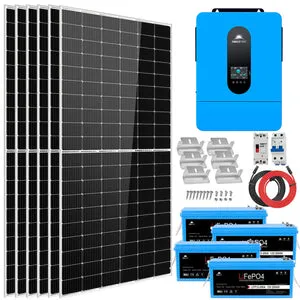
Complete Off-Grid Solar Kit 6500W 48V 10.24kWh (SGK-65PRO)
Best OverallPremium

1. Complete Off-Grid Solar Kit 6500W 48V 10.24kWh (SGK-65PRO)

SunGoldPower

$4,500–$6,000

A genuine whole-cabin power plant: 6500W split-phase 120/240V inverter, 2,700W of panels, and 10.24kWh of LiFePO4 in one bundled kit, at a price per watt-hour DIY-friendly homesteaders consistently praise.

Best for: Year-round off-grid homes that need to run 240V loads like a well pump

True 120/240V split-phase output runs well pumps, fridges, and standard home circuits · 10.24kWh LiFePO4 plus 2,700W of panels handles a real year-round cabin's daily load · Strong dollars-per-watt-hour versus name-brand all-in-ones

DIY wiring, mounting, and balance-of-system are on you · Heavy, freight-shipped, and support is value-tier rather than premium

Sources: sungoldpower.com
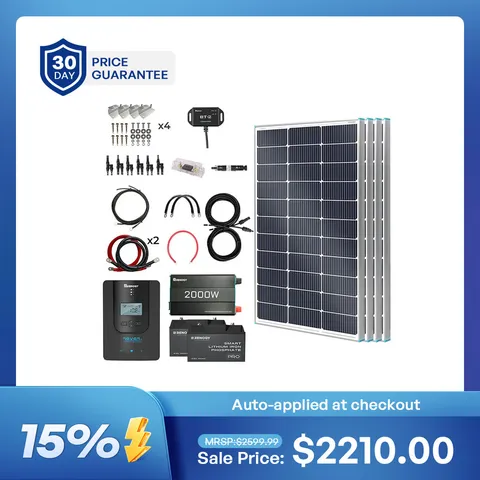
Off-Grid Core Solar Kit 7.68kWh (with ShadowFlux 400W/800W panel, 2000W inverter)
Best ValueMid-range

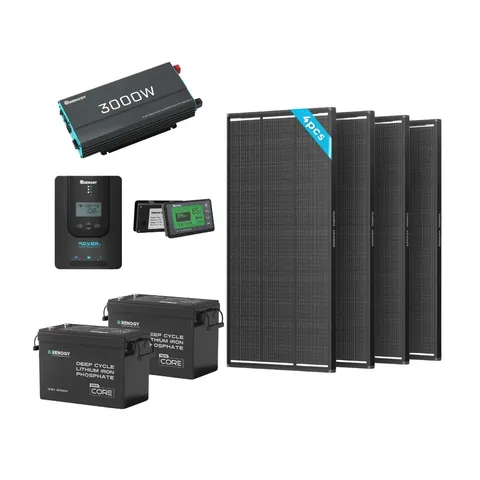
2. Off-Grid Core Solar Kit 7.68kWh (with ShadowFlux 400W/800W panel, 2000W inverter)

Renogy

$2,200–$2,900

Renogy bundles its best components (LiFePO4 storage, an MPPT controller, a 2000W inverter, and high-output ShadowFlux panels), into one expandable kit with real brand support, making it the easiest balanced cabin system to recommend.

Best for: Cabin owners who want a complete, supported system without sourcing parts à la carte

7.68kWh LiFePO4 storage covers a full day of typical cabin loads · ShadowFlux panels hold output better under partial shade · Cohesive, well-documented ecosystem with US support and expandability

Core kit excludes cables, fuses, and mounting hardware · 2000W inverter is not split-phase, so no native 240V loads

Sources: renogy.com, offgridauthority.com

DELTA Pro Ultra Smart Home Solar Kit
Best PremiumPremium

3. DELTA Pro Ultra Smart Home Solar Kit

EcoFlow

$5,000–$7,500

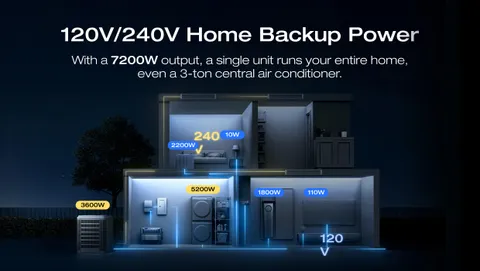
The most polished whole-home off-grid platform on the market: 7,200W output, 6kWh base storage expandable to 90kWh, 5.6kW of solar input, and app-managed switchover, with effectively zero wiring of the power electronics.

Best for: Off-grid homeowners who want whole-house power with minimal DIY electrical work

7,200W output (scalable to 21,600W) runs nearly any whole-home load · Modular to 90kWh of storage for long off-grid autonomy · Clean app control and fast, near-plug-and-play installation

Highest cost-per-kWh of any pick here · Smart Home Panel install for full 240V backup may need an electrician

Sources: us.ecoflow.com, outboundpower.com, offgridstores.com

AC200MAX with PV350 Solar Panel
Editor's PickMid-range

4. AC200MAX with PV350 Solar Panel

Bluetti

$1,800–$2,400

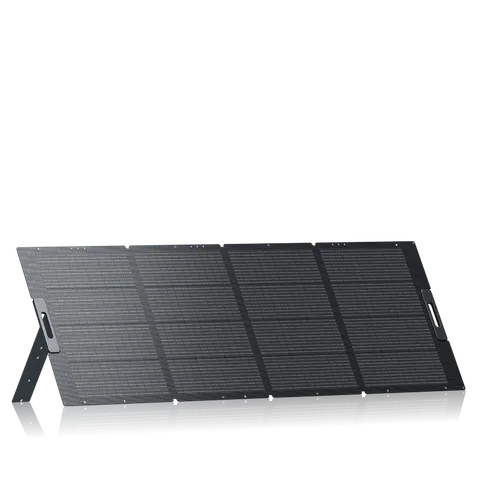
A sweet-spot all-in-one for the cabin that's outgrowing portable power: 2,048Wh of LiFePO4 and a 2,200W inverter out of the box, expandable to 8,192Wh, paired with a foldable 350W panel.

Best for: Weekend-to-part-time cabins wanting a no-wiring system they can expand later

Expandable from 2,048Wh to 8,192Wh as your needs grow · 2,200W pure sine inverter handles most cabin appliances · Truly plug-and-play, no wiring, unfold the panel and charge

Single PV350 panel charges the base in 7–14 hours; add panels for faster harvest · Per-kWh cost is higher than a comparable DIY 48V build

Sources: amazon.com, bluettipower.com

Solar Generator 2000 Plus Kit (6kWh, with 2x SolarSaga 200W)
Mid-range

5. Solar Generator 2000 Plus Kit (6kWh, with 2x SolarSaga 200W)

Jackery

$2,000–$2,700

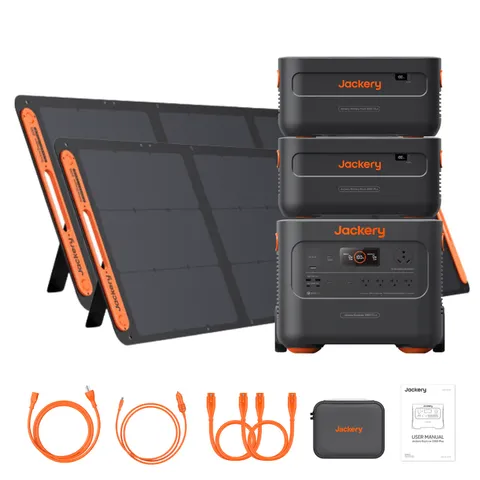
A 2,042Wh / 3,000W LiFePO4 station bundled with two 200W panels and an expansion pack, scalable to 24kWh, a rugged, well-reviewed bridge between portable power and a fixed cabin system.

Best for: Cabins and RVs wanting durable, expandable plug-and-play power

3,000W output runs heavy appliances most portables choke on · Expandable to 24kWh for extended off-grid stays · Rated ~4,000 cycles to 70%; IP65-protected ports and tank-like build

61.5 lb base unit is a two-person lift on stairs · Premium price for the capacity versus DIY 48V kits

Sources: jackery.com, powerstationlab.com, offgridstores.com

2340W 48V Off-Grid Solar Kit with 4.8kWh Lithium Battery
Mid-range

6. 2340W 48V Off-Grid Solar Kit with 4.8kWh Lithium Battery

ECO-WORTHY

$2,400–$3,200

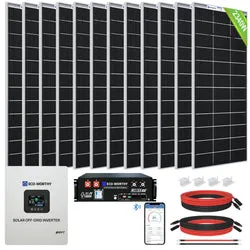
A complete 48V starter home system (twelve 195W panels, an MPPT off-grid inverter, and 4.8kWh of LiFePO4), at an aggressive price that undercuts the name brands for small-cabin loads.

Best for: Budget-minded owners of a small cabin or tiny home wanting a full 48V system

Complete kit: panels, MPPT inverter, and 4.8kWh battery included · 48V architecture leaves room to add panels and batteries · Among the lowest cost-per-watt complete systems available

Value-tier components and documentation; expect a hands-on install · Support and shipping lead times can lag the premium brands

Sources: eco-worthy.com, ecoflow.com

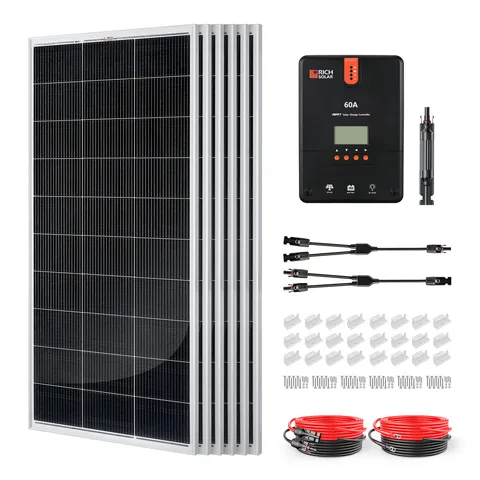
1200 Watt Solar Kit with 60A MPPT Charge Controller
Budget

7. 1200 Watt Solar Kit with 60A MPPT Charge Controller

Rich Solar

$1,200–$1,600

Rich Solar's cabin sweet spot for the array itself: six 200W monocrystalline PERC panels, a 60A MPPT controller, combiner box, and connectors, a high-value harvesting front end you pair with your own battery and inverter.

Best for: DIYers building a custom off-grid system around their own battery and inverter

1,200W of quality mono PERC panels at a low cost per watt · 60A MPPT controller and combiner box included · Flexible foundation for a custom DIY off-grid build

No battery bank or inverter, those are added separately · Cables, fusing, and racking not all included

Sources: richsolar.com, offgridauthority.com

400W 12V Complete Solar Panel Kit with 2.4kWh Battery
Mid-range

8. 400W 12V Complete Solar Panel Kit with 2.4kWh Battery

Renogy

$1,800–$2,100

A self-contained small-cabin system: 400W of panels, an MPPT controller, an inverter, and 2.4kWh of LiFePO4 storage, all from one ecosystem: enough for lights, charging, and a small fridge.

Best for: Small or seasonal cabins needing a tidy, complete starter system

Complete out of the box: panels, controller, inverter, and battery · Renogy's mature, well-documented 12V ecosystem and support · Right-sized and affordable for weekend or seasonal cabins

2.4kWh and 12V limit you to modest, mostly small loads · Less headroom to scale than a 48V platform

Sources: renogy.com, offgridstores.com

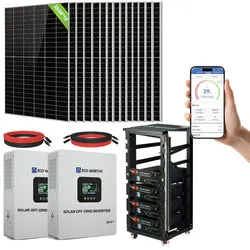
10kW Complete Off-Grid Solar Power System (13.34kWh, 4920W panels)
Premium

9. 10kW Complete Off-Grid Solar Power System (13.34kWh, 4920W panels)

ECO-WORTHY

$6,500–$9,000

Maximum capacity for the dollar: a 120V/240V system with 4,920W of panels and 13.34kWh of LiFePO4, aimed at full-time off-grid homes that want the most storage and array per dollar spent.

Best for: Full-time off-grid households maximizing storage and panels on a budget

13.34kWh storage and ~4.9kW array suit a full-time off-grid home · 120V/240V output for standard and 240V household loads · Lowest cost-per-kWh of any whole-home pick here

Large freight install; racking and AC integration are on you · Value-tier brand, vet support and warranty before committing

Sources: eco-worthy.com

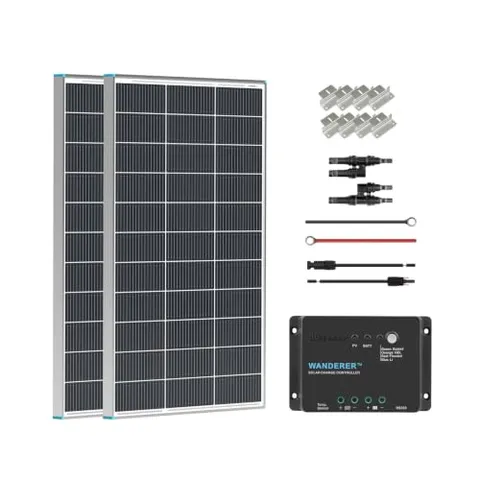
200W 12V Monocrystalline Solar Panel Starter Kit (2x100W, 30A Controller)
Best BudgetBudget

10. 200W 12V Monocrystalline Solar Panel Starter Kit (2x100W, 30A Controller)

Renogy

$250–$320

The classic entry point: two 100W mono panels with a charge controller and cabling for under $300: perfect for lights, charging, and small DC loads at a hunting or weekend cabin.

Best for: Weekend or hunting cabins needing basic lights and device charging

Inexpensive, proven way to start an off-grid setup · Mounting brackets and wiring included for a fast install · Easily expanded by adding panels and a battery later

No battery or inverter included, DC charging only as shipped · 200W only covers lights and small-device charging

Sources: amazon.com, renogy.com

How we choose

We ranked by how well each kit serves a real off-grid homeowner or cabin dweller (completeness (does it actually store and invert power, or just make it?), capacity matched to honest daily loads, build quality and cold-weather battery behavior, expandability, and dollars-per-usable-watt-hour), not by price alone. Tiers reflect total system scope: budget kits ($250–$1,600) are starter arrays and small DIY bundles for lights, charging, and a few small loads; mid kits ($1,800–$3,200) are complete battery-backed systems sized for a typical cabin's 3–5 kWh/day; premium kits ($4,000+) are split-phase whole-home systems that run pumps, fridges, and HVAC. We consulted manufacturer spec sheets, multiple retailer listings, and independent 2026 reviews to verify availability and street pricing. We earn no commission that influences placement, take no payment for inclusion, and list honest trade-offs for every pick; the rankings are ours alone.

Common questions

Add up your daily watt-hours. A modest cabin with LED lighting, an efficient fridge, a water pump, and device charging typically uses 3–5 kWh per day, which calls for roughly 1.5–2 kW of panels and 5–7 kWh of usable battery so you can ride through a cloudy day. A weekend-only cabin with lights and charging can get by on 200–600W of panels and 1–2 kWh of storage. Always size the battery to at least one full day of autonomy, and panels to recharge that battery in the shortest winter days you'll actually be there.

A DIY kit (Renogy, SunGoldPower, ECO-WORTHY, Rich Solar) ships separate panels, a charge controller, a battery bank, and an inverter that you mount and wire yourself. You get far more watts and storage per dollar and can build to whole-home scale, but you handle the cabling, fusing, racking, and any code/permitting. An all-in-one (Bluetti, Jackery, EcoFlow) integrates the controller, battery, and inverter into one cased unit, you just unfold the panels and plug in. It costs more per kWh and is harder to expand infinitely, but there's nothing to wire and nothing to get wrong.

For a primary off-grid system in 2026, choose LiFePO4. It delivers about 80–90% usable depth of discharge versus ~50% for lead-acid, lasts 3,000–6,000 cycles instead of a few hundred, needs no watering or ventilation, and weighs far less. Nearly every kit here ships LiFePO4 for that reason. Lead-acid (AGM/flooded) only makes sense as a bare-bones budget bank where upfront cost trumps lifespan, but note that in deep cold, lithium can't safely charge below freezing without a heated battery or low-temp cutoff, so confirm cold-weather support if your cabin goes unheated in winter.

Buy panels and batteries you can grow into, but you rarely need to overbuy on day one. Most modern kits are modular: all-in-ones like the Jackery 2000 Plus and EcoFlow Delta Pro Ultra chain on extra battery packs (up to 24 kWh and 90 kWh respectively), and 48V DIY systems let you add panels to the MPPT and batteries in parallel. The one thing that's painful to change later is the system voltage and inverter, going from 12V to a 48V split-phase platform means replacing the core. If whole-home power is even a maybe, start at 48V.

The 30% Residential Clean Energy Credit generally applies to solar-plus-storage that's permanently installed at your residence, including off-grid systems and the battery bank: which can turn a $5,500 kit into roughly $3,850 effective. Portable solar generators you can pick up and carry away are a grayer area and often don't qualify. Keep all receipts, and confirm your specific situation with a tax professional, since eligibility hinges on the system being a permanent fixture of the home.

Read the bill of materials carefully: many DIY kits list only the "core" components (panels, controller, battery, inverter) and leave out roof or ground-mount racking, longer cable runs, DC fuses and breakers, a battery disconnect, and a combiner box. Renogy's Core kits and Rich Solar's panel kits both note these exclusions. Budget another $200–$600 for mounting and balance-of-system hardware on a DIY build, and factor in your own labor or an electrician for the AC side.

Some links are affiliate links, and we may earn a commission at no extra cost to you. It never affects our rankings.

In your pocket

Take your land with you.

Free, no account needed. Planning tools, public-land maps, and field tools built for off-grid country.

  • Public-land boundaries in your pocket. No subscription

  • Walk a boundary with GPS and see its real shape

  • Plan the route out to the parcel and save it

  • GPS tracking that keeps recording where signal never reaches

Nearby places standing on the real terrain in 3D in the Off Grid Hubs app

Ready to launch?

Ready to give your community
better tools?

Free GPS parcel maps, fire monitoring, road reports, and community tools, branded for your community and ready in about a week.