When you're buying off-grid land or building a remote cabin, waste management becomes urgent fast. Most people assume they need a conventional septic system: then discover the permitting nightmare, the $8,000–$15,000 bill, or worse, that their soil won't perk for conventional drainage. Composting toilets and septic systems aren't interchangeable options; they solve fundamentally different problems and carry different trade-offs. Which one you choose depends on your soil, water table, local code, usage patterns, and willingness to be hands-on. This guide walks you through the real costs, permitting reality, and day-to-day living experience so you can make the call that fits your property and lifestyle.
How They Actually Work
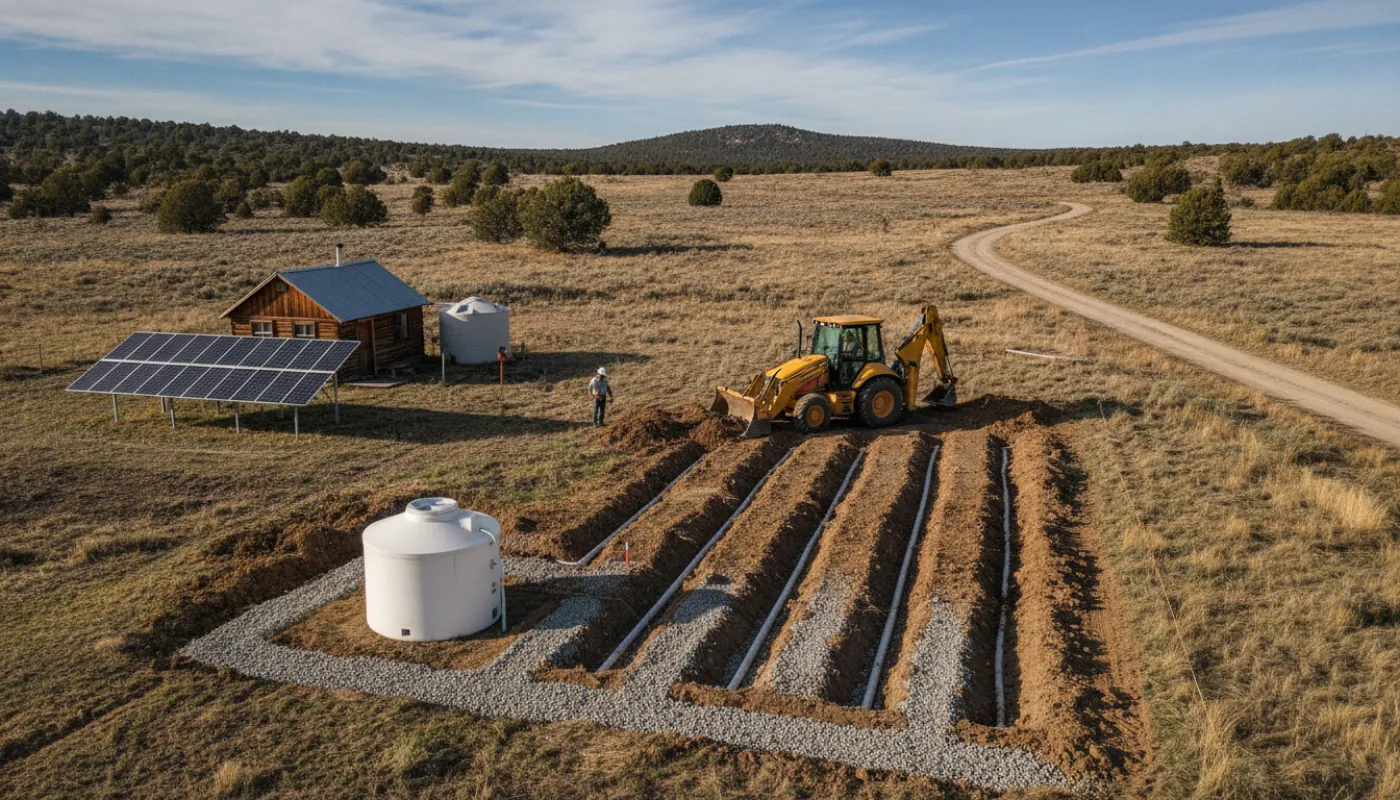
A composting toilet breaks human waste down into usable compost through aerobic decomposition and carbon-rich bedding material, storing the final product in a tank beneath the seat. Septic systems, by contrast, rely on anaerobic bacteria in an underground tank to partially decompose waste, then distribute the liquid, called effluent, into a drain field buried in your soil. The key difference: composting toilets don't produce a liquid discharge that needs to filter through soil, while septic systems depend entirely on soil absorption.
This distinction matters because it determines where each system can legally work, how much space you need, and what happens if something goes wrong. Composting toilets need airflow and carbon management but are indifferent to soil type and groundwater depth. Septic systems need soil with the right permeability (sandy loam works, clay doesn't), and they must stay set back from your water well (commonly 50 feet from the tank and 100 feet from the drainfield) and your property lines. Understanding this difference prevents thousands of dollars in misspent investment on unsuitable land.
Cost & Installation Reality
Composting toilet systems typically run $3,000–$7,000 installed, including the toilet fixture, ventilation, and possibly a gray-water system for sinks and showers. This is a one-time cost with no moving parts to fail and no need for contractor expertise, many owners install them themselves with a few YouTube tutorials and basic plumbing. If you're building from scratch, you'll need a small concrete pad or cabin foundation, but no excavation, no soil tests, no drain field construction.
Septic systems start around $5,000 for a basic two-chamber tank in ideal soil but routinely run $10,000–$20,000+ when you factor in percolation testing, soil remediation (sand mounds or engineered systems), contractor design, permitting fees, and inspections. If your land has poor drainage, you're looking at a mound system or other expensive alternative. Pumping costs run $300–$500 every three to five years, depending on tank size and usage, adding hundreds to your lifetime budget. The system also has moving parts (baffles, distribution boxes, leach field pipes), that fail and require replacement.
Permitting and Code Reality
Here's where composting toilets are often easier, but "easier" is not "exempt." Some counties permit them with a single-page form; others require an NSF/ANSI 41-certified unit, and many do not accept a composting toilet as satisfying the dwelling's onsite-wastewater code at all. Crucially, a composting toilet handles only the toilet stream, your cabin still produces greywater from sinks and showers, and the code often still expects an approved greywater or onsite-wastewater plan regardless. Installing one rarely makes you code-compliant by itself. Call your county before assuming you can skip a permit.
Septic permitting is a labyrinth. Your county's health department requires a percolation test (perc test) to measure how fast your soil drains. If the percolation rate is too slow (clay, clay loam, or silt), you fail and must install an expensive alternative: a sand mound, a pressure distribution system, or a constructed wetland. Permitting alone can take two to four months and costs $500–$2,000 in fees. Some counties deny septic permits on small lots or in sensitive groundwater areas, leaving you with no conventional option at all. If you're near a floodplain or have a shallow water table, expect additional scrutiny and design costs.
A few jurisdictions still ban composting toilets outright, particularly in older suburbs, but rural off-grid properties almost never face this restriction. Call your county health department before buying land, it's a five-minute conversation that prevents a six-figure mistake. Ask specifically whether they allow "waterless" or "dry" toilet systems and what the requirements are.
Living with Your Choice: Day-to-Day Reality
Composting toilets are low-maintenance but not zero-maintenance. You add carbon material (sawdust, peat moss, or coconut coir), after each use (a cup or two from a bin next to the toilet). This takes five seconds and becomes automatic. The ventilation fan runs continuously or on demand to prevent odors. Tanks need emptying every one to three years depending on usage and system size; a family of four in year-round use might empty annually. When you empty it, the material still needs care: most home composting toilets don't sustain the high temperatures that kill pathogens, so the output is not finished, safe compost. It should be further composted or buried, used only on non-food plants (never a vegetable garden), and handled per your jurisdiction's rules for composted human waste, treat it as partially processed waste, not yard trimmings. The entire process is straightforward but requires active participation, if you forget carbon or ignore maintenance, you'll know it immediately through smell or pest issues.
Septic systems are invisible until they break. You pump the tank every three to five years, and ideally you avoid flushing anything except human waste and toilet paper. But the system is also largely hands-off: you don't think about it, and it works quietly for years. The trade-off is that repairs are expensive and often urgent. A failed drain field can mean a $5,000–$15,000 system replacement. Pumping frequency depends on household size and water usage, high water consumption fills tanks faster, leading to more frequent (and expensive) pumping cycles.
Making Your Decision
The wrong system for your land is the biggest mistake. If your soil won't perc, a conventional septic system is impossible, period. Composting is your answer. Similarly, if your seasonal high water table sits too close to the surface, a conventional drainfield can't keep the required vertical separation (commonly two to four feet below the trench), which pushes you to a mound or engineered alternative, or, in the worst case, a denial. Composting toilets operate in any soil and any season. Check your county's soil maps and water-table data before committing to either choice.
For year-round off-grid living with a family or guests, composting toilets work best when you're comfortable with minimal upkeep and comfortable producing and managing compost. They're ideal for smaller properties where drain-field setbacks make septic impossible, and they're the only practical choice in areas with permitting obstacles. If you're building a seasonal cabin with low usage, the low installation cost and instant approval make composting the financial winner.
Septic systems suit property owners with larger holdings, conventional building plans that banks and insurance companies recognize, and a preference for invisible infrastructure. They work where soil is suitable and permitting is straightforward. The higher cost pays dividends in property value (resale buyers recognize septic as standard) and long-term ease. Choose based on your soil, your water table, your code jurisdiction, and your tolerance for hands-on management, not on guesswork or what your neighbor did.