Greywater (the relatively clean wastewater from sinks, showers, and washing machines), is one of the biggest decisions first-time off-grid builders get wrong. Many assume they can dump it anywhere or ignore local rules, then learn too late that their county forbids it, fines them, or requires expensive remediation. Others install systems that fail within a few years because they didn't account for soil type or seasonal water table. The good news: legal, durable greywater solutions exist at every budget level, from $200 mulch basins to $2,000 constructed wetlands. This guide walks you through the legal landscape, the most common and reliable systems, and how to avoid the mistakes that trap off-gridders.
Understanding Greywater and Your Local Rules
Greywater is wastewater from bathroom sinks, tubs, showers, and laundry. One exception matters: most greywater codes classify kitchen-sink and dishwasher water as blackwater (or exclude it) because of the grease, food particles, and pathogens it carries: only a few states (Arizona, Oregon, Washington, Montana) allow kitchen water in a greywater system. Toilet water is always blackwater. In most states, using greywater is not illegal; what is illegal is installing a system without a permit or ignoring county-specific rules. Some jurisdictions allow unrestricted household greywater reuse. Others require a design plan by a licensed engineer. A few prohibit it entirely on septic properties or in sensitive groundwater areas. The only way forward is to contact your county health department or environmental health office before you build.
When you call, ask three questions: (1) Is greywater reuse permitted on my property? (2) What are the required design standards (setbacks from wells or property lines, soil percolation rates, depth restrictions)? (3) Do I need a permit, and if so, what documentation do they need? Write down the name of the person who answers so you have a record. Many counties have written guidance documents on greywater; if yours does, request a copy and build to it. You will almost certainly find that a properly designed system is legal. The risk is not the system itself, it is skipping this step and guessing.
Whatever you build, a handful of pathogen-safety rules are universal. Use greywater within about 24 hours, don't store it, because bacteria multiply fast in standing greywater. Keep it below the surface (subsurface pipe or mulch-basin infiltration, never sprayed), and never let it pool or run off your property. Use only low-sodium, boron-free, chlorine-free "plant-friendly" soaps. And never irrigate root vegetables or anything eaten raw: greywater goes on fruit and nut trees, berry bushes, and ornamentals, not the salad bed.
Constructed Wetlands: The Most Reliable Option
If your budget allows, a constructed wetland is the gold standard for off-grid greywater. It is passive, durable, and forgiving of operator error. The system works by gravity-feeding greywater through a shallow basin planted with wetland vegetation (cattails, rushes, iris), that filters and biologically treats the water as it percolates into the ground.
A typical residential system is 12 to 20 feet long and 6 to 10 feet wide, with 18 to 24 inches of water depth during normal use. You build it with an impermeable liner (usually 60-mil EPDM rubber), gravel substrate, and a perforated underdrain pipe that carries treated water out the bottom. Greywater enters at one end via a distribution box; the plants and gravel do the work; clean water exits the underdrain. The system requires almost no maintenance, you clear debris occasionally and cut back vegetation once a year. In cold climates, depth matters: the water column and soil insulate the system enough to handle freeze-thaw cycles, though in extreme cold you may need to reduce winter use or add a cover.
Cost runs $1,500 to $3,000 for a DIY build, including the liner, excavation, gravel, and perforated pipe. Engineered designs are cheaper if your county accepts a simple rule-of-thumb sizing (typically 1–2 square feet of surface area per gallon per day of expected greywater). Most off-grid cabins with two to three people generate 30 to 50 gallons per day of laundry and sink water, so a 50–100-square-foot wetland is standard. The main gotcha: wetlands require good drainage below them, if your water table is within 3 to 4 feet of grade, the system pools and fails. Test your percolation rate with a simple percolation test (dig a hole, fill it, and measure how fast it drains) before committing to this design.
Laundry-to-Landscape: The Budget Option
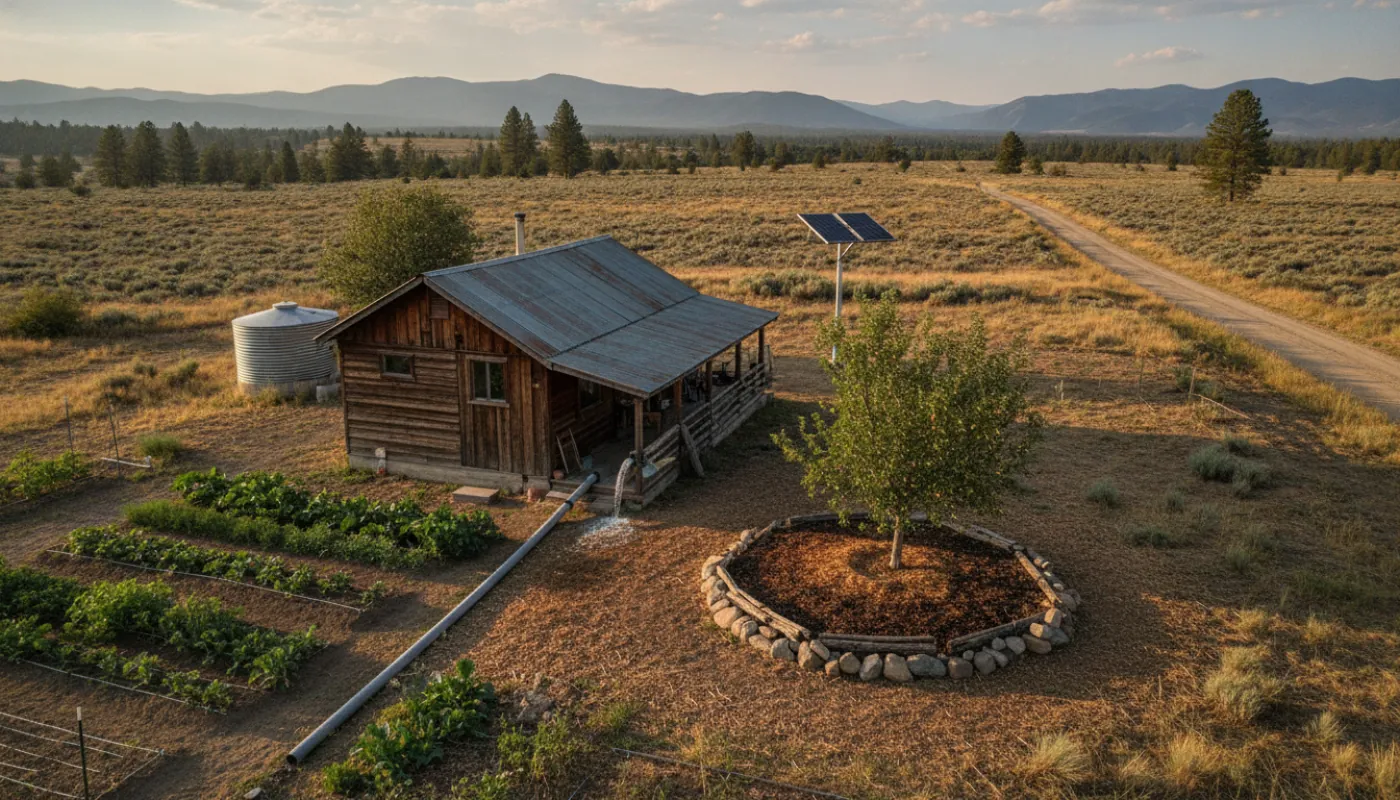
If a wetland is overkill or your budget is tight, laundry-to-landscape (L2L) is a proven workaround. This system captures only washing-machine water, which is 30 to 50 percent of household greywater, and distributes it to mulch basins around trees or shrubs. You need three things: a "branched drain" or valved outlet manifold that sits under the washing machine, insulated outdoor piping to the garden, and landscape plants that tolerate occasional soap.
The branched drain is a PVC manifold with 1-inch outlets, each discharging into a mulch-filled basin under a tree or shrub, not into buried drip emitters, which greywater's lint and particles quickly clog. The mulch keeps the outlets covered and lets water infiltrate slowly. On a two-person cabin, the modest laundry flow, perhaps 60 to 150 gallons a week, can support a few fruit or nut trees or berry bushes. Keep it to trees and above-ground plants, never root crops or anything eaten raw. The advantage is simplicity: no excavation, no liner, no bioengineering. The disadvantage is that you are limited to laundry water and require healthy, well-draining soil. If your topsoil is clay or caliche, L2L will puddle and fail.
Setup cost is $200 to $600: a branched drain kit ($80–$150), drip lines, and trenching. You can build the manifold yourself from PVC fittings if you are handy. The main rule is to keep lines sloped gently (never flat) and insulated, in freezing climates, you need to flush the lines and close ball valves at the end of winter or drain them completely. Many off-gridders run L2L for half the year and shut it down when ground freezes.
Mulch Basins and Simple Surface Infiltration
For the smallest budgets or simplest setups, mulch basins offer a middle ground. This is essentially a sunken garden bed, a 3-by-6-foot basin dug 18 to 24 inches deep and filled with wood chips and mulch. There is no impermeable liner; the whole point is that water infiltrates through the mulch into the native soil below. You run bathroom sink and shower drain lines (not kitchen, not laundry) into the basin. The mulch acts as a biofilter; plants (or just decomposing organic matter) consume nutrients; the soil does final percolation.
The system is cheap, $150 to $300 in materials, and requires almost no design. The catch is that it only handles low-flow greywater (sinks and showers, not laundry), and it works only in well-draining soil. In clay, it becomes a swamp. You also need to replace the top layer of mulch every couple of years as it decomposes. Because the basin is open to rain and surface runoff, it can accept overflow from heavy use, making it forgiving during wet seasons. In dry climates, the basin doubles as a soil amendment source and can support ornamental plantings. It is not a long-term solution for high-flow households but works well for seasonal cabins or minimal use.
Getting It Right From the Start
The most common mistake is installing a greywater system before calling the county. The second most common is sizing the system for an imagined future of heavy use instead of actual usage. A two-person off-grid cabin produces far less greywater than a suburban home, and many systems are oversized and fail from inadequate flow.
Start with a percolation test on your property. Call your county health department and ask for a standard soil evaluation or use a simple DIY test: dig a 12-inch hole, fill it with water, and measure how long it takes to drain. Fast-draining soil (sandy, gravelly) supports any system. Slow-draining soil (clay, silt) limits you to constructed wetlands or simple mulch basins in above-ground plantings. Then, with that data and your county's rules in hand, sketch a system, or hire a local engineer for a few hundred dollars if your county requires a stamp. Buy the materials, build it, and trust it. Greywater systems that follow the basics (good drainage, appropriate sizing, and legal design), run for 20 years without intervention. Those that cut corners fail in five.